Corporate Governance in Georgia: How to Keep Control as Your Business Grows
When an owner approves every payment, leads every negotiation, oversees sales and makes every significant decision, the business moves fast — but the real quality of control remains unclear. Corporate governance reduces that uncertainty. It defines who makes decisions, to whom they are accountable, what information they rely on, and how outcomes are verified.
Most businesses in Georgia operate as limited liability companies (LLCs), often run directly by one or a few partners. That is why governance is not only a concern for large or listed companies. An owner-managed LLC, a fast-growing business and the Georgian subsidiary of an international group need governance on different scales, but on the same principles: financial information must be timely and reliable, authority clearly allocated, and risks assessed regularly.
What Corporate Governance Covers
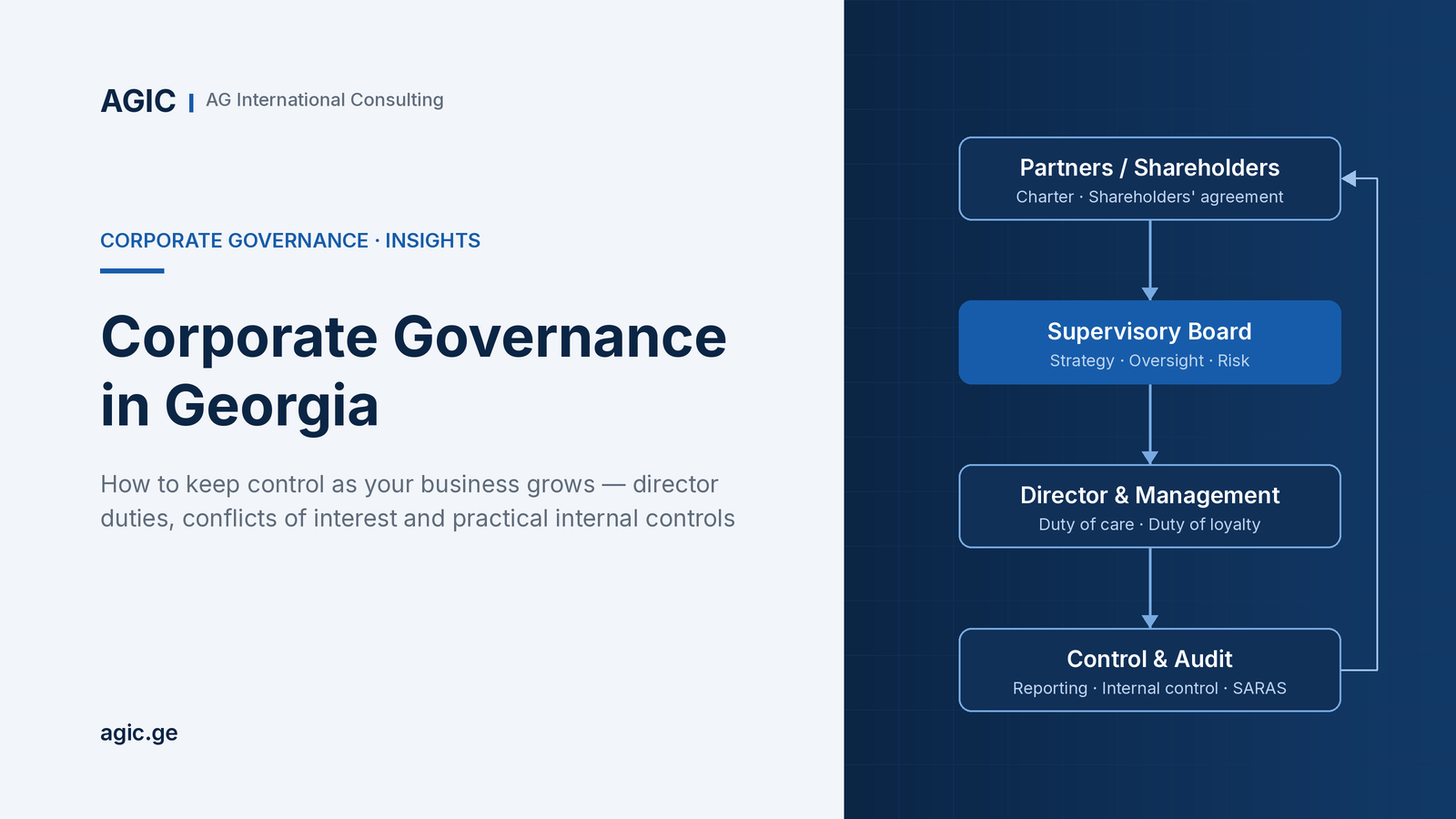
Corporate governance is the system of rules, roles, controls and decision-making processes that connects partners (shareholders), directors, the supervisory board and control functions. Its purpose is not to constrain management's day-to-day work. It is to ensure that the business acts in line with the company's interests, its approved strategy, the law and sound financial discipline.
Accountability is the foundation. A director should know which matters they can decide independently and when they need approval from the partners' meeting, the supervisory board or another authorised body. A CFO or chief accountant should present not only the numbers, but where they come from, the assumptions behind them and material variances from plan. The owner, in turn, should evaluate results without stepping in to replace operational management.
Effective governance typically includes:
• partners' rights and decision-making rules (charter, shareholders' agreement);
• responsibilities of directors and, where one exists, the supervisory board;
• authority limits and an approval matrix;
• rules and frequency of financial reporting;
• management of conflicts of interest and related-party transactions;
• independent review procedures.
Not every business needs every component at the same depth — but their absence usually becomes visible during a crisis.
The Legal Framework: What Georgian Law Requires
In Georgia, governance is not just a matter of best practice — its core elements are set by law.
The Law of Georgia on Entrepreneurs (in force since 1 January 2022) imposes fiduciary duties on managers:
• Duty of care — a director must act in good faith and with the diligence of a prudent person, in the company's best interests;
• Duty of loyalty — personal interests, or those of related persons, must not prevail over the company's interests;
• Conflict-of-interest management — a conflicted director must disclose the interest and abstain from the decision; certain transactions require prior approval;
• No misuse of corporate opportunities — a director may not take a company's business opportunity for personal or third-party benefit without consent.
Breaching these duties can make a director personally liable for resulting damage and, in some cases, render a transaction invalid. Limits on a director's authority and approval requirements can be set in the charter or a shareholders' agreement. In practice, banks check these limits before lending — so an unclear or outdated charter can directly delay financing.
A supervisory board is generally optional for an LLC, while a joint stock company must establish one in the cases set by law (for example, a reporting enterprise whose securities are traded).
The Law of Georgia on Accounting, Reporting and Auditing classifies entities into four size categories and separately defines public interest entities (PIEs). Annual financial statements are submitted to the Service for Accounting, Reporting and Auditing Supervision (SARAS) via reportal.ge by 1 October of the year following the reporting period. Statutory audit is mandatory for PIEs and for Category I and II entities.
In regulated sectors — banks, insurers and microfinance organisations — the National Bank of Georgia sets additional governance requirements.
Tax is part of governance too. Under Georgia's "Estonian-model" profit tax, not only dividends are taxable, but also expenses unrelated to economic activity and free-of-charge supplies. An owner's personal expenses paid by the company are therefore not just a control gap — they create an additional tax liability. Transactions with foreign related parties and with residents of preferential-tax jurisdictions fall under transfer pricing rules (Articles 126–129¹ of the Tax Code): prices must meet the arm's-length principle, and documentation must be provided within 30 days of a Revenue Service request.
Why Governance Starts with Financial Data
Management cannot control what it cannot see. If monthly reports are late, bank balances are not reconciled, receivables are not fully tracked, or reported profit does not reflect real liabilities, decisions by the board or owner rest on assumptions.
A minimum system of reliable financial information combines:
• regular management reporting;
• budget-versus-actual comparison;
• a cash flow forecast;
• a register of material contracts and commitments;
• monitoring of tax positions and filing deadlines.
For members of foreign groups or companies with international investors, this extends to group reporting deadlines, documentation of intercompany transactions, and aligning Georgian requirements (SARAS, tax) with group standards such as IFRS or US GAAP.
The distinction between bookkeeping and management reporting matters. Bookkeeping records transactions under set rules; management reporting shows leadership what decisions the data supports. Revenue growth can look positive in the accounts, for example, yet become a problem if receivables are rising quickly and cash flow is deteriorating. For more, see our article on financial reporting for business.
Segregation of Duties Reduces Errors and Conflicts
In a small company, one person may negotiate a deal, approve the invoice and initiate the payment. Limited resources sometimes make this unavoidable, but it carries a high risk of error, misspending and fraud. Control starts with a sensible separation of functions.
In practice, no single person should control the full cycle — from selecting a supplier to making the payment and booking it. Where headcount does not allow this, compensating controls can include:
• periodic review by the owner;
• independent checks of bank statements;
• dual authorisation and payment limits in internet banking;
• involvement of an external accountant or auditor.
Related-party transactions deserve particular attention. A deal with a partner, a director or a company connected to them is not a problem in itself. Problems arise when the terms are undocumented, the market basis is unclear or the decision was not properly approved. In Georgia, such transactions carry a double risk: corporate (conflict of interest under the Law on Entrepreneurs) and tax (non-market pricing or a hidden profit distribution). Either way, both the accuracy of the financial statements and partners' trust suffer.
The Supervisory Board and Management Do Different Jobs
Having a supervisory or advisory board does not automatically produce good governance. The board's role is to oversee strategic direction, financial performance, material risks and management's work. It should not become a body that runs day-to-day operations, because that blurs the lines of accountability.
At the same time, formal meetings and upbeat presentations are not enough. Board or partner discussions should leave room for hard questions:
• How realistic is the sales forecast?
• How would changes in prices or the exchange rate affect profit?
• Does the company have enough liquidity?
• What tax or contractual risks exist?
• Who is tracking delivery of corrective actions?
Control Does Not Mean Bureaucracy
A common mistake is copying large-corporate rules straight into a small business. Multi-step approvals, too many committees and complex paperwork can slow operations without materially reducing risk. The right model depends on company size, ownership structure, degree of regulation, geographic footprint and growth plans.
Business stage
Minimum governance toolkit
New / owner-managed LLC
Simple approval matrix, monthly financial pack, quarterly partner review
Fast-growing company
Formal budgeting, risk register, legal-financial review of key contracts, independent internal or external review
Member of an international group
Alignment of Georgian and group policies, transfer pricing documentation, group reporting calendar
Effectiveness is measured by the quality of decisions, not the volume of documents. If approvals are timely, exceptions are visible, responsibility is traceable and reporting shows the real picture, control helps the business. If the process has become signature-collecting, it fails governance's purpose.
Warning Signs of Weak Governance
Problems can stay hidden for years, especially while revenue grows and cash is still sufficient. But several signals call for early action:
• the owner receives key financial information only at year-end or in a crisis;
• a budget exists, but variances from actual results are not discussed;
• one person approves payments and contracts without a second-level review;
• the charter and shareholders' agreement do not reflect the director's actual authority and approval rules;
• tax obligations and reportal.ge filings are handled reactively, as deadlines approach;
• related-party transactions, partner loans or personal expenses are poorly documented;
• audit, accounting or tax recommendations recur, but no owner or deadline is assigned.
None of these necessarily means a breach. But each indicates that the business needs a process diagnostic, risk prioritisation and a practical action plan.
How to Strengthen Corporate Governance: 4 Practical Steps
1. Map decision rights. Who approves spending, who signs contracts, who sees the financial statements and who checks delivery? This map quickly exposes both excessive concentration and gaps in accountability.
2. Review the charter and shareholders' agreement. They should reflect the Law on Entrepreneurs and actual practice: director authority limits, transactions requiring approval, the conflict-of-interest procedure and profit distribution rules.
3. Introduce a governance calendar. Include month-end close and reporting dates, monthly tax filing deadlines, annual submission on reportal.ge (by 1 October), budget review frequency, partners' meetings and audit milestones. The calendar creates a rhythm that brings issues to management's attention on time.
4. Make internal policies practical. Rules on spending, procurement, travel, related-party transactions, data access and document retention should be short, clear and workable. A policy employees cannot use does not strengthen control.
Combining independent audit, tax and accounting perspectives is particularly valuable here. AGIC's multidisciplinary team helps management avoid treating accounting accuracy, tax compliance and governance risk as separate issues. The goal is one system in which data, controls and decisions are aligned.
Frequently Asked Questions
Does a small LLC need corporate governance?
Yes, in a simple form. Director duties and conflict-of-interest rules under the Law on Entrepreneurs apply to all companies. A small business is often well served by an approval matrix, a monthly financial pack and regular partner reviews.
Is a supervisory board mandatory?
Generally not for an LLC. For a joint stock company, yes, in the cases set by law. Additional requirements apply in the financial sector.
When is an audit mandatory in Georgia?
Under the Law on Accounting, Reporting and Auditing, audit is mandatory for public interest entities and Category I and II entities. Banks, investors and donors often require one as well.
What risks do related-party transactions create?
Corporate risk (conflict of interest and breach of approval rules) and tax risk (non-market pricing, hidden profit distribution and, for foreign related parties, transfer pricing).
Conclusion
Good governance is not created by a one-off document or by setting up a formal board. It is built through consistent practice: management receives reliable information, difficult issues are discussed in time, and agreed actions are tied to named owners and deadlines. That discipline is what lets a business grow without losing control.
This article is for general information only and does not constitute legal or tax advice. Please consult a specialist about your specific situation.
Need a corporate governance diagnostic, internal control design or audit readiness support? Get in touch — agic.ge